

Executive Summary:
History does not repeat, but it certainly rhymes. Often to the beat of a 60 year drum. In Part 2 of this series, we move beyond the theory of Saṃvatsara cosmology and into the cold, hard data of the financial markets. By backtesting over a century of DJIA and NASDAQ data, this report reveals a startling correlation between the five year elemental Yugas and the recurring phases of market "Ignition," "Euphoria," and "Destruction."
In this report we’ll explore:
The Yuga Growth Curve: A breakdown of the five-year elemental sequence that governs why markets shift from "real growth" to "emotional narrative" before collapsing into ruin.
The Deity Driven Rotation: Why specific Vedic gods align with historical bull markets
A comparative analysis of 1929, 1989, and 2026
⏱ Estimated Read Time: 20 Minutes
THE ECONOMICS OF THE SAṂVATSARAS
Welcome to part two. In part one of this series, we explored how the synodic cycle of Jupiter and Saturn constructs a 60 year cycle within Vedic cosmology, each year holding its own unique Sanskrit name and archetype.
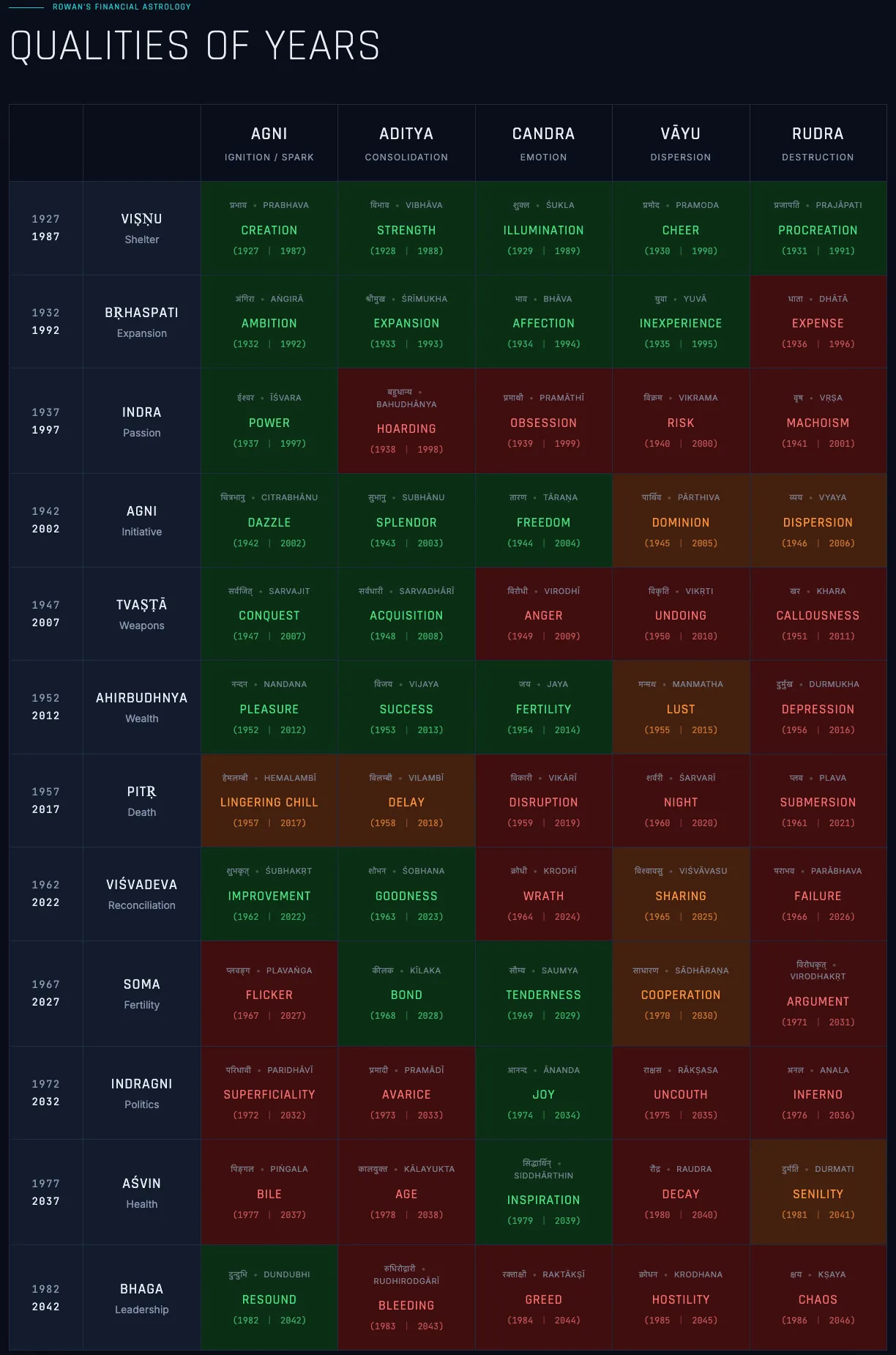
But what can this cycle tell us regarding the markets, finances and economics?
2026 | THE PARĀBHAVA YEAR (पराभव)
The two years that fall under the year of Rudra in the Yuga of Visvadeva are 1966 and 2026. This specific year is called Parābhava. In Sanskrit, this translates to defeat, failure, downfall, falling into non-existence, being overpowered, loss of status, or ruination.
We have already seen echoes of this energy, such as the Iran invasion, which has set the geopolitical and economic tone for the rest of the year. Rudra rules the destructive element, while Visvadeva rules the collective, universal aspect of the year. Therefore, this destruction will not be localized. This is an overarching theme that will impact us all financially.
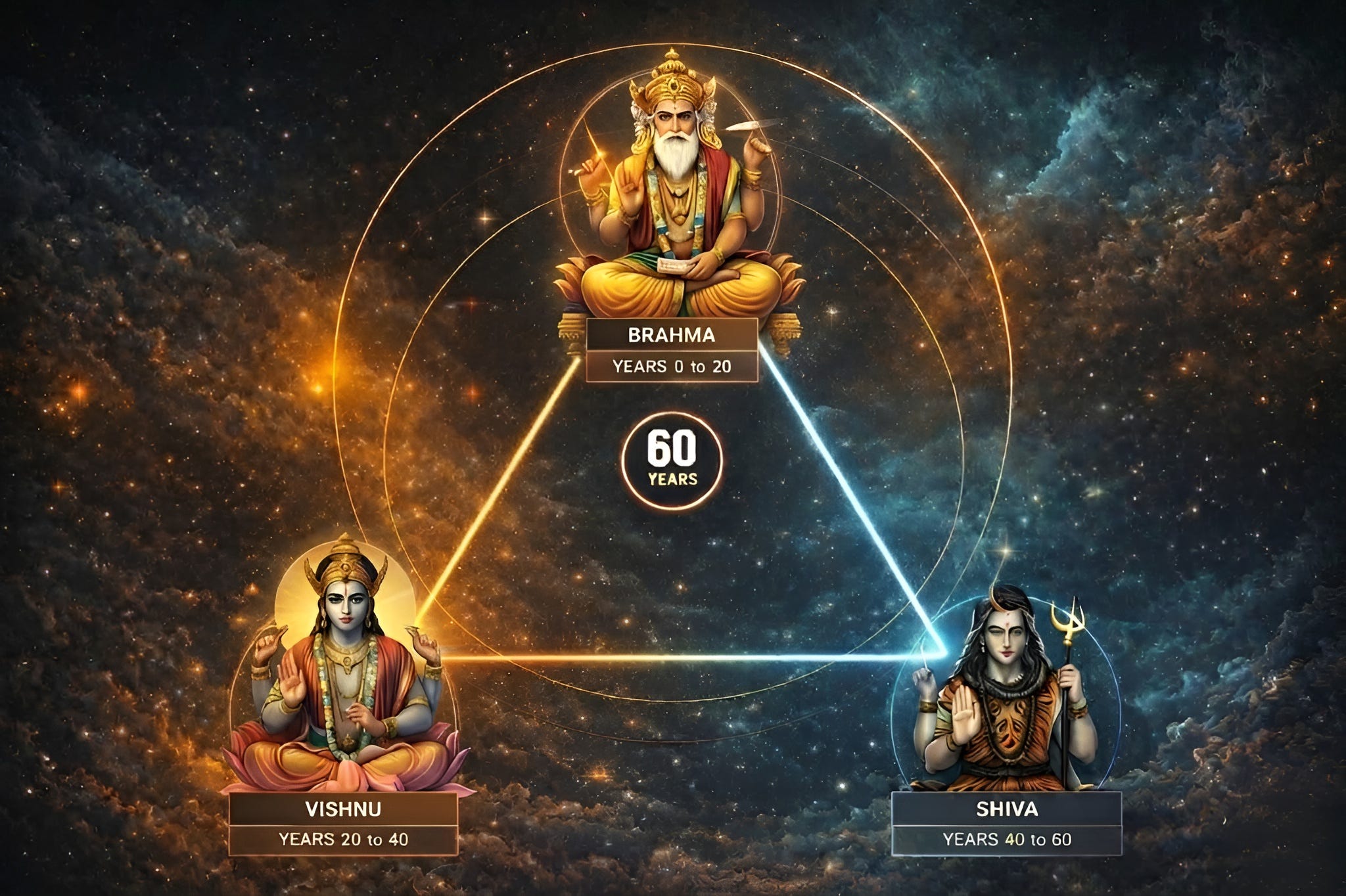
Parābhava is the 40th year in the 60 year cycle. It marks the absolute end of the maturation and sustenance period ruled by Vishnu, and the beginning of the destruction and transformation period ruled by Shiva. Shiva initiates the transformation phase of the 60 year cycle by first putting the world into this state of Parābhava.
Because the Visvadevas represent the "all," a downfall occurring in their Yuga is rarely just a personal stroke of bad luck. It suggests a collective reckoning. It acts as an archetype of "Global Dissolution," where systems, institutions, or societal norms that affect everyone begin to crumble. We are already seeing this narrative dominate the news in 2026: the old world order is fracturing.
THE FINANCIAL SIGNALS OF THE SAṂVATSARAS
Can this ancient cycle reveal any real economic and market signals?
The primary dataset used for this research was the Dow Jones Industrial Average (DJIA). I selected the DJIA over the S&P 500 because it provides the longest continuous, reliable data, stretching back to 1927, which conveniently aligns with the beginning of our first Epoch of the 60 year Saṃvatsara cycle.
