

Executive Summary:
The Bṛhat Saṃhitā of Varāhamihira is an ancient Vedic text that details Vedic Astrology’s unique 60-year cycle: the Bṛhaspati Chakra. The archetypal correlations of these years are shockingly accurate. But can we use these Saṃvatsaras to gain a tangible advantage in the markets?
In this report we’ll explore:
How to calculate the Vedic 60 year cycle.
The striking archetypal alignment between the Saṃvatsaras and historical global events (including the COVID-19 years).
How we can weaponize this ancient cycle for modern financial analysis.
⏱ Estimated Read Time: 20 Minutes
“What has been will be again; what has been done will be done again; there is nothing new under the sun.” - Ecclesiastes 1:9
What do Vedic Astrology, Chinese Astrology, and W.D. Gann have in common? They all recognized that time is fundamentally cyclical.
The Mayans used interlocking calendars to track repeating cycles. Vedic cosmology is explicitly cyclic. Traditional Chinese astrology utilizes a sexagenary (60-year) cycle, and ancient Celtic cultures operated on the wheel of the year.
When did we become so disconnected from this reality? Our modern Western society has conditioned us from childhood to perceive time as linear - a logical, straight-line progression from A to B to C. This linear bias is so deeply ingrained in the Western mind that adopting any other framework feels radical.
But pay attention, and you'll notice your entire existence is ruled by cycles. You claim to have free will, yet your body chemistry operates on a strict circadian rhythm, governed by hormonal, digestive, and sleep cycles. You wake up, go to work, get paid monthly, and eat dinner at the same time every day. Your emotions, moods, actions, and ultimate results in life are inherently tethered to this built-in cyclical mechanism.
No one can overcome this. Try to willpower your way out of your sleep cycle for 72 hours, and you’ll succumb to sleep deprivation psychosis. Ignore the cyclical signals of your digestion system, and you won't last a month. Aligning your life with time cycles isn't just esoteric theory; it is highly practical and directly aids your survival.
Winter, Spring, Summer, Fall. Creation, Maintenance, Destruction. Desire, Action, Result. Empires rise and fall, and our lives experience inevitable peaks and troughs. The very basis of all sound in existence is a complex combination of sine waves that assemble into everything you hear. There are seasons to everything.
“There is a tide in the affairs of men, which, taken at the flood, leads on to fortune; omitted, all the voyage of their life is bound in shallows and in miseries.” - William Shakespeare, Julius Caesar
CYCLES IN THE FINANCIAL MARKETS
If we as individuals are governed by cycles, then certainly the collective is, too. And if the collective is governed by cycles, we can predict massive shifts in human action and global events. Financial markets are not exempt from this universal phenomenon, contrary to what the megalithic power structure of the financial industry would like you to believe (Spoiler: they do not have your best interests at heart).
It is on this foundational truth that "cyclical analysis" exists as a legitimate branch of technical analysis. W.D. Gann built an entire methodology around time cycles. James Hurst developed "Hurst Cycles." Kondratiev proposed the Kondratiev Waves. We have already demonstrated the power of the 18.6-year real estate cycle. Traders regularly use the four stage market cycle: accumulation, markup, distribution, and markdown (Wyckoff Analysis).
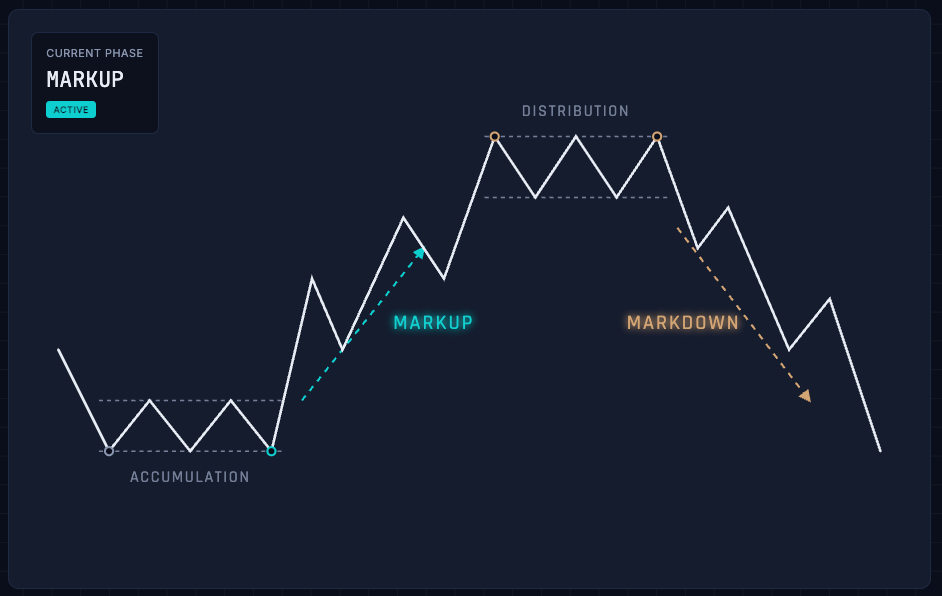
Consumer psychology and market activity are undeniably governed by cyclical momentum, yet investors still risk their capital while chained to linear thinking. The old adage, “Over time, the stock market goes up,” might be technically true, but it is incredibly simplistic, leaves you vulnerable to massive drawdowns, and leaves entirely too much money on the table.
In this two part series, we are diving deep into Vedic Cosmology’s proprietary 60 year Saṃvatsara cycle. We will learn why it works, how it operates, and link it directly to historical market activity to analyze exactly where we are right now, and where we are headed next. This might get complex, but it will fundamentally upgrade your understanding of yearly cycles.
PART 1 | WHAT IS THE SAṂVATSARA CYCLE?
I’d like to fully credit my learning of this model to the fantastic Mr Vic Dicara, a master Jyotishi who kindly allowed me to borrow the graphics that he produced for my own unique research into this topic.
“Saṃvatsara” (संवत्सर) literally translates to “a full year" or "a complete year.” But, because Sanskrit is a multi-dimensional language, it carries vastly deeper translations. Consider these valid alternative translations:
“The Combined Year / The Master Year” | Refers to the seniority this cycle holds in Vedic cosmology, operating just outside the massive Mahayuga cycles.
“The Dwelling Place of Living Beings” | Refers to the temporal container in which our collective karma unfolds.
“The Complete Circuit” | A master time cycle crucial for anticipating major shifts.
Instead of the standard 365 day solar year that dictates our modern calendar, the Saṃvatsara cycle is defined as a “Jovian Year” (a year of Jupiter). It is calculated by tracking the orbital mechanics of the two most prominent Grahas (or planets) in Vedic Astrology and Astronomy - Jupiter (Bṛhaspati) and Saturn (Śani).
Since Jupiter takes roughly 12 years to circle the zodiac (regardless of which one you use) and Saturn takes roughly 30 years, their least common multiple is 60 years.
5 Jupiter Cycles = 60 Years.
2 Saturn Cycles = 60 Years.
At the end of a 60-year period, Jupiter has completed five full orbits around the Sun, and Saturn has completed two. During this time, they conjoin every 20 years. Because both planets are moving forward along the ecliptic, each meeting happens roughly 120 degrees further along the zodiac wheel.
Check out the below animation of this cycle in full screen mode:
Notice how Jupiter returns to the same point in the cycle every 12 years - watch the counter hit 12, 24, 36, 48 and 60. There is one 20 year section, a second conjunction that happens after 20 years 120 degrees apart, and a final conjunction that happens 20 years later 120 degrees after the previous one.
While its original discoverer is lost to pre-history, this cycle is formally documented in the Bṛhat Saṃhitā, an astronomical work accredited to Varāhamihira in approximately 505 to 587 CE. Chapter 8 of this text is titled “Bṛhaspati-cāra” or “The Movements of Jupiter.”
Varāhamihira’s specific contribution was dividing the 60 year Bṛhaspati Chakra into 12 sub cycles (Yugas) of 5 years each. Why 5 years? Because Jupiter cycles the zodiac 5 times within the 60 year master cycle.
Each 5 year Yuga contains years with specific names and symbolic archetypes
SAṂVATSARA YUGAS | THE ARCHETYPES OF THE YEAR
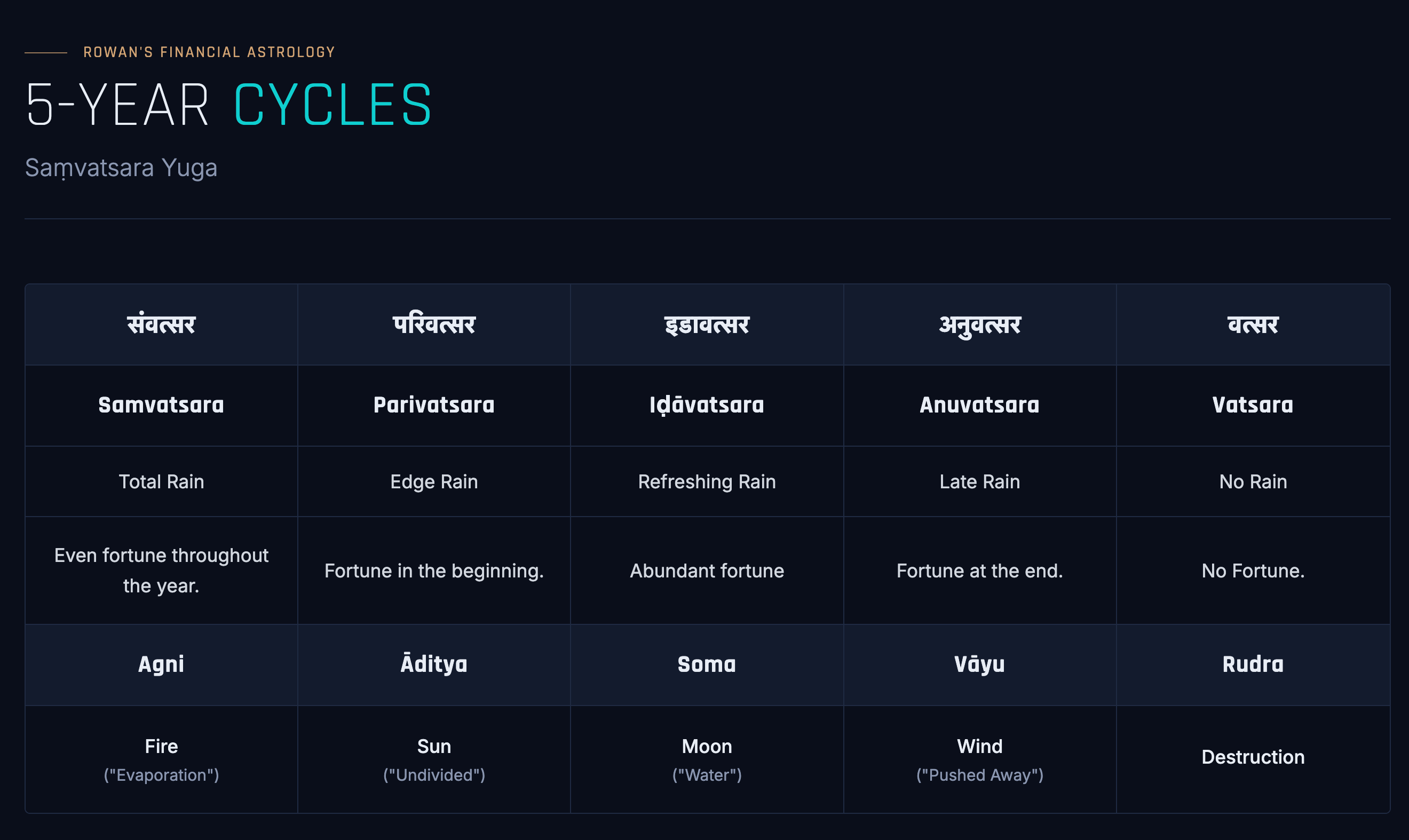
Within any 5-year Yuga, the years follow a strict sequence of fortune and quality:
Samvatsara: Total rain. Equal fortune and growth throughout the year.
Parivatsara: Edge rain. Fortune at the beginning of the year, tapering off later.
Idavatsara: Abundant rain. Heavy fortune throughout the year.
Anuvatsara: Late rain. Fortune arrives at the tail end of the year.
Vatsara: No rain. Drought, scarcity, and lack of fortune all year.
Furthermore, Varāhamihira assigned a specific Vedic deity to rule each year, imbuing it with a predictable archetype:
Samvatsara (Agni): Fire, Heat, Ignition, Initiative.
Parivatsara (Aditya): The Sun, The Whole, Consolidation.
Idavatsara (Soma): The Moon, Water, Feminine Nourishment.
Anuvatsara (Vāyu): Wind, Dispersion, Pushing Away, Spreading.
Vatsara (Rudra): The Destroyer, necessary destruction to birth a new cycle.
When we map these 5 year cycles across the 12 ruling deities of the larger 60 year cycle, a highly specific matrix emerges. Let’s start the cycle using 1927 as “Year Zero.”
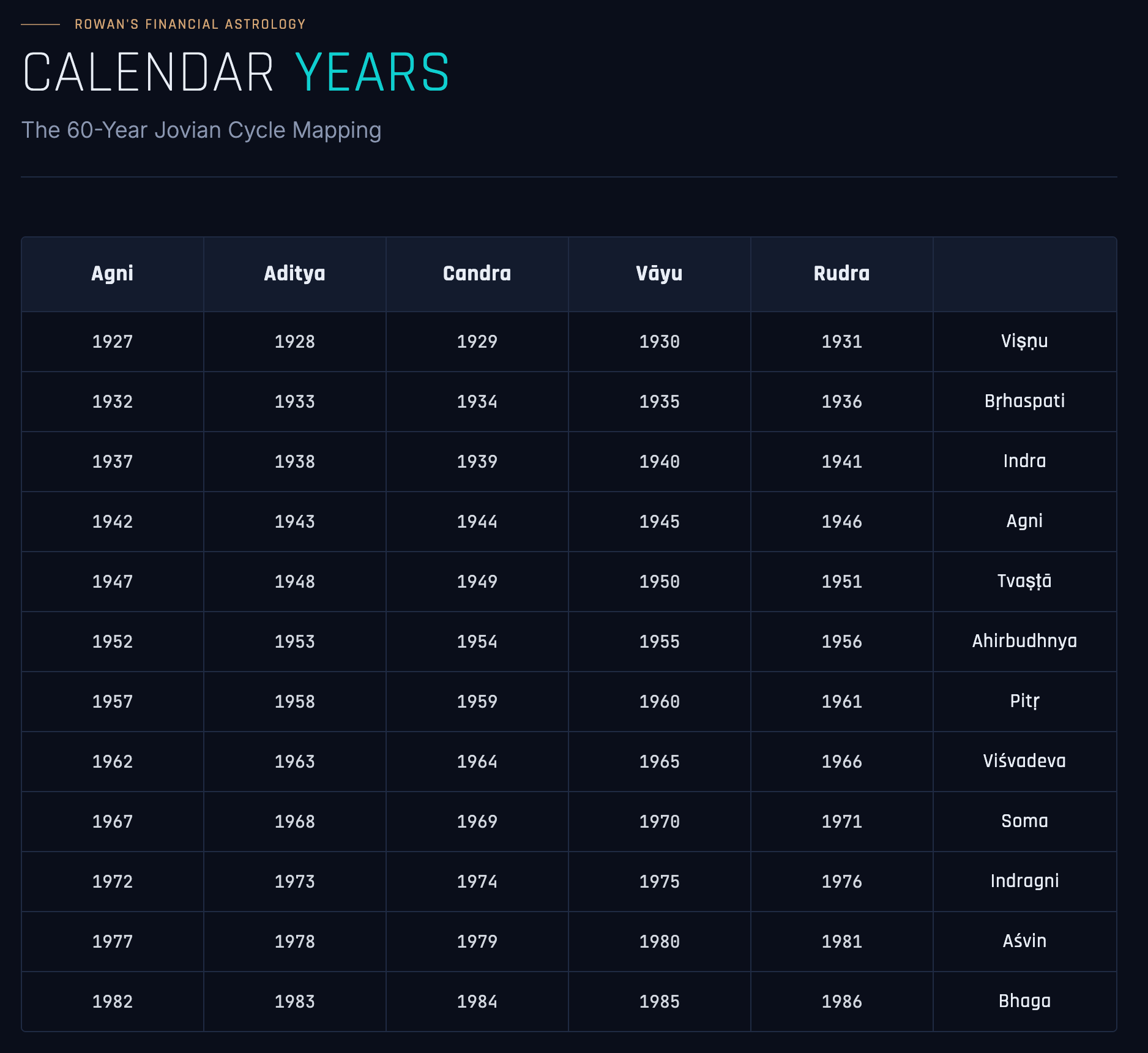
You might be saying “Ok Rowan, I see the gods you just mentioned on the top, but what about the gods on the side?” These gods give greater detail to the archetypes of the year. To put it briefly:
Vishnu = Shelter
Brihaspati = Expansion
Indra = Passion
Agni = Initiative
Tvaṣṭā = Engineering & Weapons
Ahirbudhnya = Wealth
Pitṛ = Death
Visvadeva = Unification
Soma = Fertility
Indragni = Politics
Asvin = Health
Bhaga = Leadership
Agni = Initiative
Aditya = Consolidation
Chandra = Emotion
Vayu = Dispersion
Rudra = Destruction
So, each year has a specific quality to it determined by the blend of significations of the associated gods. So, we can create the following matrix.
HOW TO READ THE MATRIX | HISTORICAL PROOF
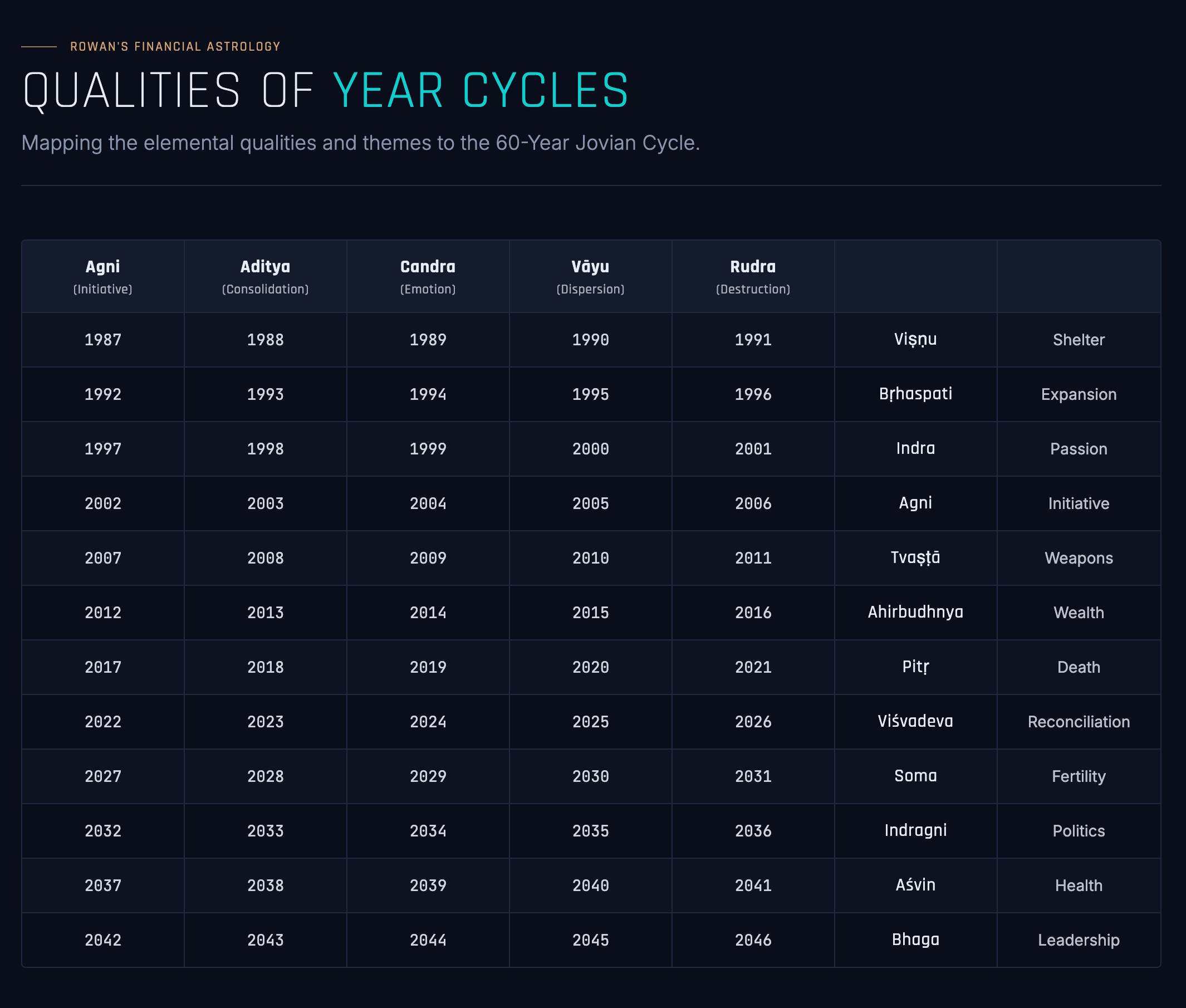
How do we make sense of all this? Let's look at a recent example: 2020.
2020 was a Vāyu (Wind/Dispersion/Air) and Pitṛ (Death) year. What did we experience globally? An airborne virus that spread across the planet, resulting in mass casualties.
To prove this isn’t a fluke, let’s look at the cycle beginning in 1927.
